The Phenomenon of Bloody Sweat

Photobucket

Photobucket
This rare medical condition is known as hematidrosis, or, hematohidrosis. Rather than some kind of obscure condition, though it’s rare, history, apart from the account of Christ, is full of examples of this occurring. In fact, Leonardo da Vinci, wrote the account of a solider who sweat blood before battle. I also recall hearing an account of a young girl who living in or near London during the blitz sweat blood out of fear. The blood vessels around the sweat glands rupture, the blood seeping into the glands, and it pushes the blood and sweat to the surface. The experience is said to be rather painful, for the skin becomes extremely tender.


http://brandondevotional.wordpress.com/2012/02/28/2-corinthians-134-on-christs-perfect-and-obedient-weakness/

ON THE PHYSICAL DEATH OF JESUS CHRIST

Shroud

Health of Jesus
The rigors of Jesus' ministry (that is, traveling by foot throughout Palestine) would have precluded any major physical illness or a weak general constitution. Accordingly, it is reasonable to assume that Jesus was in good physical condition before his walk to Gethsemane. However, during the 12 hours between 9 PM Thursday and 9 AM Friday, he had suffered great emotional stress (as evidenced by hematidrosis), abandonment by his closest friends (the disciples), and a physical beating (after the first Jewish trial). 
Also, in the setting of a traumatic and sleepless night, had been forced to walk more than 2.5 miles (4.0 km) to and from the sites of the various trials. These physical and emotional factors may have rendered Jesus particularly vulnerable to the adverse hemodynamic effects of the scourging.
http://www.catholicculture.org/culture/liturgicalyear/overviews/seasons/lent/passion3.cfm

The Crucifixion of Jesus (the) Christ From A Medical Perspective

Roman Flagrum Product Review Cat Of Nine Tails Cat O Nine Tails

The Crown of Thorns


The builders of the cathedral

The building of Notre-Dame de Paris is part of the architectural explosion which lasted from the 11th to the end of the 14th century in western Europe, and especially in France.
In Paris , Bishop Maurice de Sully initiated the project. Though he was of humble stock, a peasant's son of Sully-sur-Loire, and thus had no personal income that enabled him to provide the funds for the building of the new cathedral, he remarkably managed his ecclesiastical income and therefore his financial contribution was of first importance. 

His successors: the first, Eudes de Sully, and other bishops such as Guillaume d'Auvergne or Simon Matifas de Buci, were eager in their own task to complete the building or to make some significant alterations.
The bishop was helped in his task by the chapter which, from the 9th century onwards, had grouped all the canons ministering in the cathedral. As documents are lacking, we don't know whether, during the 12th century, the chapter provided funds regularly to the work or not. Anyway, during the 13th century, as this chapter had its own benefices, it took a more and more important part in managing the work site, especially the building of the Hotel-Dieu (the Cathedral hospital).
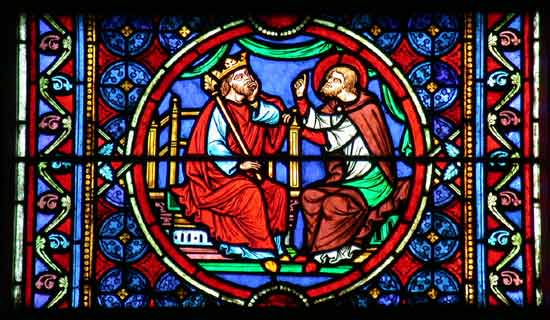
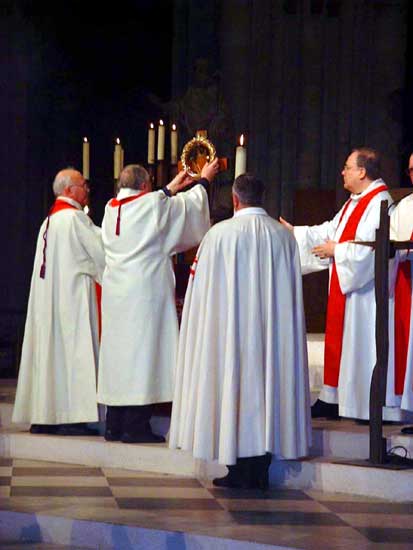


In the 13th century, it was pledged and then purchased by King Saint Louis who had the 'Sainte Chapelle' built in Paris to house it.
During the French Revolution, the Crown of Thorns was kept in the Bibliotheque Nationale (French national library).
In 1801 the Concordat with Rome gave it back to the Archbishop of Paris who in 1806 brought it to the Cathedral treasury where it remains.
The relic is as a ring of twisted rushes, to which thorns were attached to form the Crown.
Napoleon I and Napoleon III each gave a reliquary to protect it. The first reliquary is neo classical and the second is neo gothic, made by Viollet-le-Duc's workshop. Both are permanently exhibited in the Cathedral treasury.


http://whitemouse.ru/photo/paris/cite_ndp.wmb

Ash Wednesday

Image

Image

What is Ash Wednesday?
What is Ash Wednesday? For most of my life, I didn’t ask this question, nor did I care about the answer. I, along, with most evangelical Christians in America, didn’t give Ash Wednesday a thought.
But then, in 2004, Ash Wednesday loomed large in American Protestant consciousness. Why? Because on that day Mel Gibson released what was to become his epic blockbuster,The Passion of the Christ. 
For the first time in history, the phrase “Ash Wednesday” was on the lips of millions of evangelical Christians, not just Catholics and other “high church” Protestants, as we anticipated the official release of The Passion. Every since 2004, many who never wondered about Ash Wednesday have been asking: What is Ash Wednesday? How do we observe it? Why should we observe it?
http://www.patheos.com/blogs/markdroberts/series/ash-wednesday-practice-and-meaning/

'Christ Carrying Cross'

เทศกาลมหาพรต ถ่อมใจมากๆ ทานน้อยๆ ร่วมพระมหาทรมาณ กับพระเยซูเจ้าครับ

ของ Tiepolo